Light the Flame of Freedom.

25 George Washington Quotes Every American Should Know
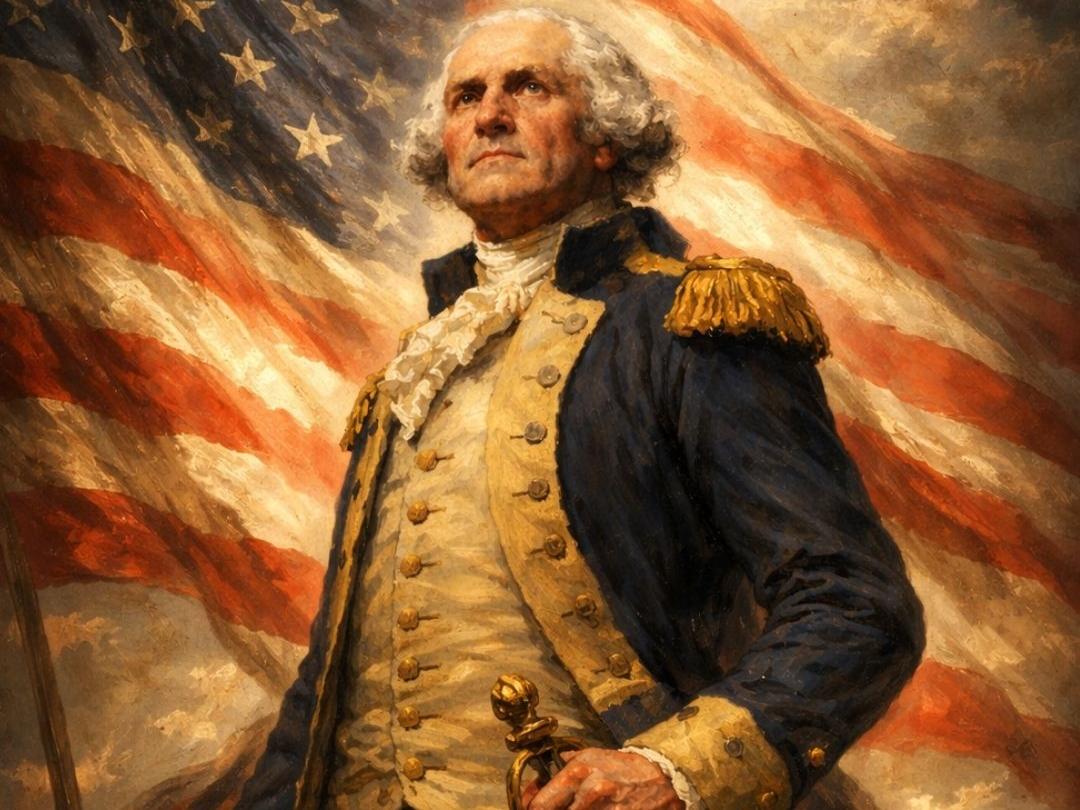
Verified from primary sources. No myths. No internet fabrications. Just the man himself.
A lot of "George Washington quotes" floating around the internet are either fake, completely fabricated, or shared by people who just never checked the source. These aren't.
Every quote below comes straight from Washington's letters, military orders, and official addresses, authenticated and sourced. Washington talked about leadership, duty, faith, and freedom, forged those values under fire, then handed them to us.
What he believed built this country, and what he warned against is exactly what threatens it today.
Here are 25 Washington quotes every American should know — and remember.
George Washington on Leadership
Washington practiced what he preached. He demonstrated leadership it at Valley Forge, he practiced it when his own officers questioned him. and he practiced it when he voluntarily surrendered power after two terms… a move so unprecedented it stunned the world.
Quote 1
"Discipline is the soul of an army. It makes small numbers formidable; procures success to the weak, and esteem to all."
— Letter of Instructions to the Captains of the Virginia Regiments, July 29 1757
While many mistakenly take discipline for punishment, Washington understood that it's the very thing that makes ordinary people capable of extraordinary outcomes. This applies as much to a business, a family, or a country as it does to an army.
Quote 2
"Example, whether it be good or bad, has a powerful influence."
— The Writings of George Washington
Washington knew his men were watching him: every decision, every reaction, every moment of pressure. He was not distant, directing from afar.
He crossed the Delaware in a blizzard with his men. He starved at Valley Forge alongside them. When the situation demanded sacrifice, Washington stepped into it first.
That's the kind of example that requires no speech. Men follow a leader who demands of himself what he demands of others.
Leaders who wonder why their teams underperform should start by looking at the example they're setting.
Quote 3
"...it is better to offer no excuse than a bad one, if at any time you should happen to fall into an error."
— Letter to Harriot Washington, October 30, 1791
Washington wrote this to his niece Harriot, one of several orphaned relatives he and Martha took in and raised at Mount Vernon. She had sent him a short letter, clearly rushed, because a family member was about to leave for the post office and she hadn't written sooner. Washington noticed. He pointed out, not unkindly, that she'd had plenty of time and that her excuse for the short letter wasn't much of one.
It's easy to reach for an explanation when you fall short. Washington's point is that a weak excuse doesn't soften a failure; it adds to it. Own it or fix it. Don't dress it up.
That standard didn't vary based on who was watching or what was at stake. He held his niece to it, and he held himself to it. It's a small line from a private letter, and it says much about the character of the man who wrote it.
Quote 4
"Associate yourself with men of good quality, if you esteem your own reputation; for 'tis better to be alone than in bad company."
— Rules of Civility & Decent Behavior in Company and Conversation
Before he commanded armies or led a nation, a teenage Washington sat down and hand-copied 110 rules of conduct from a French Jesuit guide written in 1595 (likely as a penmanship assignment). What started as a handwriting exercise became the moral framework he carried for the rest of his life. Rule 56 is this one. A man's reputation, Washington understood, is inseparable from the company he keeps.
Surround yourself with people of poor character long enough, and their standards quietly become yours. Washington chose his circle carefully and guarded his character, as should we.
Quote 5
"There is but one straight course, and that is to seek truth and pursue it steadily."
— Letter to Edmund Randolph, 1795
Washington wrote this on July 31, 1795 — in the middle of the Jay Treaty crisis, one of the most explosive political controversies of his presidency. Foreign powers were meddling, political factions were in open war with each other, and Washington's own Secretary of State would soon be accused of accepting bribes from France.
With all of that swirling around him, Washington put his answer on paper in a single sentence. Seek truth. Pursue it steadily.
In a world where pressure invites compromise and noise drowns out conviction, the man who built this country treated truth-seeking as a discipline — one practiced daily, regardless of what it cost.
Quote 6
"I hope I shall possess firmness and virtue enough to maintain what I consider the most enviable of all titles, the character of an honest man."
— Letter to Alexander Hamilton, August 28, 1788
Before he became president, before the presidency even existed, Washington wrote down what he wanted most to be remembered as. Every title he'd earned — soldier, commander, statesman — and the one that mattered most to him was honest man.
That title is available to anyone willing to pay the daily price of it. The question Washington was really asking himself is the same one worth asking today: when everything is stripped away, what will your character say about you?
George Washington Quotes on Freedom and Liberty
Washington earned his words on freedom the hard way: eight years of war, sacrifice, and personal cost most people will never know. The blessing is that we get to absorb these lessons from the words of one who lived them — as long as we're paying attention.
Quote 7
"The freedom of Speech may be taken away—and, dumb & silent we may be led, like sheep, to the Slaughter."
— Address to Officers of the Army, March 15, 1783
Washington understood that the freedom to speak, to dissent, to voice a grievance, is the first freedom everything else depends on. A people who lose their voice lose the ability to protect anything that follows. Every American who still has the God-given freedom to speak should be using it.
Quote 8
"Let us therefore animate and encourage each other, and show the whole world that a Freeman, contending for liberty on his own ground, is superior to any slavish mercenary on earth."
— General Orders, July 2, 1776
July 2, 1776, the day Congress voted for independence. Washington was in New York, outnumbered, outgunned, and facing one of the largest expeditionary forces Britain had ever sent overseas.
He wrote: "The fate of unborn millions will now depend, under God, on the courage and conduct of this army." Then he wrote this. The spirit in this quote, that free people fighting for their own land carry an advantage no empire can buy, is the DNA of this country.
Quote 9
"Liberty, when it begins to take root, is a plant of rapid growth."
— Letter to James Madison, March 2, 1788
Washington had watched what happens when free people decide they've had enough. He knew how quickly it moves.
The line carries weight in both directions: toward tyrants as a warning, toward free people as a reminder. Freedom has always been worth fighting for. The only thing it asks of us is that we refuse to let it be taken.
Quote 10
"To be prepared for war is one of the most effective means of preserving peace."
— First Annual Message to Congress, January 8, 1790
Washington wasn't advocating for war, but he was advocating for the strength that makes war unnecessary. He understood that adversaries calculate, and a prepared country changes that calculation.
A responsible military is one of the most loving things a government can provide for its citizens, because it's what allows families to sleep at night, communities to build, and a nation to thrive without looking over its shoulder.
Quote 11
"Guard against the impostures of pretended patriotism."
— Farewell Address, September 19, 1796
In his Farewell Address, Washington warned the young nation about the dangers he believed could destroy it from within: the destructive spirit of political parties, the influence of foreign powers, and the false patriotism of those who cloak ambition in the language of love of country.
Washington believed that some men would wrap selfish goals in patriotic rhetoric to make them harder to question. True patriotism, in his view, was inseparable from virtue and moral character.
Anyone willing to use the appearance of patriotism to advance their own agenda at the country's expense was, in Washington's eyes, one of its most dangerous enemies.
George Washington Quotes on Faith and Character
Faith and character aren't separate from freedom, rather they are the foundation of it. A nation that loses its moral anchor doesn't stay free for long.
Quote 12
"Labor to keep alive in your breast that little spark of celestial fire, called conscience."
— Rules of Civility & Decent Behavior in Company and Conversation
Conscience isn't something we manufacture, rather it's something God put in us. Washington understood that the battle is keeping it alive when culture, convenience, and compromise are all working to dim it.
Quote 13
"While we are zealously performing the duties of good citizens and soldiers, we certainly ought not to be inattentive to the higher duties of religion. To the distinguished character of Patriot, it should be our highest glory to add the more distinguished character of Christian."
— General Orders, May 2, 1778
Valley Forge, spring of 1778. The army has endured months of cold, starvation, and disease — but the encampment that tested everything is still ongoing.
Washington expected officers to attend Sunday services personally and set the example for their men. His point was plain: doing your duty as a soldier is necessary, but it isn't the ceiling.
The higher obligation — the one he placed above the title of Patriot — was to live as a Christian. Bravery and loyalty are good. Righteousness is better.
Quote 14
"I am sure there never was a people who had more reason to acknowledge a divine interposition in their affairs than those of the United States; and I should be pained to believe that they have forgotten that agency which was so often manifested during our Revolution."
— Letter to John Armstrong, March 11, 1792
Washington didn't attribute American independence to brilliant strategy alone. He said, openly and repeatedly, that Providence had a hand in the founding of this nation. A nation that forgets where it came from loses the gratitude for what holds it together.
Quote 15
"Happiness and moral duty are inseparably connected."
— Letter to the Protestant Episcopal Church, August 19, 1789
Washington believed you could not have a genuinely happy life built on dishonesty or selfishness. Happiness isn't a feeling to be chased, but the natural result of living rightly. That's not a popular idea in a culture that treats happiness as a destination and morality as optional. It was also Washington's firm conviction, and reality suggests he was right.
Quote 16
"The many remarkable interpositions of divine government, in the hours of our deepest distress and darkness, have been too luminous to suffer me to doubt the happy issue of the present contest."
— Letter to General Armstrong, March 26, 1781
March 1781. Washington opens this letter by calling the state of affairs "an awful crisis." He's not softening it. Then he writes this; a personal conviction grounded in what he'd already watched God do throughout the war.
The pattern of Providence had been too consistent, through too many impossible moments, for him to doubt that American independence would be won.
George Washington Quotes on Country and Duty
Washington could have been king, but he turned it down. He could have served a third term, yet he walked away. He understood something about civic responsibility that the modern world would do well to relearn: that the country is bigger than any single person, any party, or any ambition. You serve it. It doesn't serve you.
Quote 17
"Observe good faith and justice toward all nations. Cultivate peace and harmony with all."
— Farewell Address, September 19, 1796
Washington's foreign policy in a single line. Build your strength, maintain your integrity, and don't get tangled in other nations' ambitions. It was sound advice in 1796 and it remains sound today.
Quote 18
"I hold the maxim no less applicable to public than to private affairs, that honesty is the best policy."
— Farewell Address, September 19, 1796
Washington applied to government the same standard he applied to himself. Honesty wasn't a luxury he reserved for easy situations because it was the operational principle for everyday life. Deception in public office wasn't just immoral to him. It was strategically stupid. And it always catches up with you.
Quote 19
"However [political parties] may now and then answer popular ends, they are likely in the course of time and things, to become potent engines, by which cunning, ambitious, and unprincipled men will be enabled to subvert the power of the people and to usurp for themselves the reins of government, destroying afterwards the very engines which have lifted them to unjust dominion."
— Farewell Address, September 19, 1796
Washington warned against political factions in his final address to the nation. He had watched the party system begin to corrode public life even within his own cabinet — Hamilton and Jefferson at each other's throats before the ink on the Constitution was dry. He saw where it was going.
The warning every American should take from this: know who you're actually voting for, and what they're actually building — because the man waving your flag may be the one dismantling your freedom.
Quote 20
"The name of American, which belongs to you in your national capacity, must always exalt the just pride of patriotism more than any appellation derived from local discriminations."
— Farewell Address, 1796
In 1796, regional identity was already being weaponized to divide the country; Northern vs. Southern, Atlantic vs. Western. Washington saw it clearly and named it in his final address to the nation.
What you share as Americans — the same faith, the same principles, the same blood spilled for the same cause — runs deeper than any line drawn on a map. The men working to convince you otherwise, he warned, have an agenda.
Before you let a regional, political, or cultural label define your loyalties, ask yourself who benefits from that division.
George Washington Quotes on Perseverance and Wisdom
Washington lost more battles than he won. He led an army that often lacked shoes. He was betrayed by generals, undermined by politicians, and questioned by men who had done a fraction of what he'd done. And yet he kept going. What sustained him was conviction that the work was worth doing, no matter how long it took.
Quote 21
"We should never despair. Our situation before has been unpromising and has changed for the better, so I trust it will again. If new difficulties arise, we must only put forth new exertions and proportion our efforts to the exigency of the times."
— Letter to Major General Philip Schuyler, July 15, 1777
Fort Ticonderoga had just fallen — one of the most significant American losses of the war. Schuyler wrote Washington with the news, and Washington wrote back with this. A clear-eyed acknowledgment that the situation was bad, grounded in a conviction that bad situations had turned before and would turn again.
He was stating a principle he had staked his life on: harder circumstances demand greater effort. The only people who lose for good are the ones who stop.
Quote 22
"Happiness depends more upon the internal frame of a person's own mind than on the externals in the world."
— Letter to Mary Ball Washington, February 15, 1787
Washington wrote this to his own mother; an elderly woman who was frail, frequently unhappy, and convinced her circumstances were to blame. He was telling her directly: the source of contentment isn't “out there”. It's the condition of your character and your values.
A man who had wealth, fame, and power — and had watched all three fail to guarantee peace — knew exactly what he was saying. Guard your character. Everything else is circumstance.
Quote 23
"Truth will ultimately prevail where pains is taken to bring it to light."
— Letter to Charles M. Thruston, August 10, 1794
Washington believed in truth's resilience. Truth requires effort, courage, and people willing to pursue it even when it's costly. But ultimately, it prevails. Christ said "I am the way, the truth, and the life." What Washington observed from history, Scripture establishes as eternal law. Do the work of bringing truth to light. It's never wasted.
Quote 24
"We ought not to look back, unless it is to derive useful lessons from past errors, and for the purpose of profiting by dearly bought experience."
— The Writings of George Washington, 1781
Washington wasn't sentimental about failure. He had made enough consequential mistakes to know that the only productive use of a past error is the lesson you learn from it. Regret without correction is just punishment.
The man who built this country treated experience (including the painful kind) as raw material. Don't waste what it cost you to learn what you now know.
Quote 25
"The preservation of the sacred fire of liberty, and the destiny of the republican model of government, are justly considered as deeply, perhaps as finally staked, on the experiment entrusted to the hands of the American people."
— First Inaugural Address, April 30, 1789
Standing before the first Congress, Washington named exactly what was at stake, for Americans, but also for every free people who would come after. The entire republican model of government, the idea that people could govern themselves without a king, was on trial — and in some ways, still is.
The freedom you get to enjoy right now was handed to you as an experiment in progress. How you live, speak, build, and stand for your country is either honoring or wasting what was bought for you. We must all choose wisely.
The Man Behind the Words
George Washington was not a perfect man. He struggled with debt, and owned slaves for most of his life. But he was relentlessly honest about who he was and what he believed. He held himself to a standard that would have broken most people.
In a world full of noise, fake quotes, and men who borrow the flag for their own ambitions, it's worth going back to the source. The real George Washington — verified, sourced, and unspun — has more than enough to say.
____
While some paraphrases might have been included, all quotes in this post have been verified through primary sources including the Papers of George Washington (Founders Online, National Archives), George Washington's Mount Vernon digital archives, and authenticated correspondence collections. Quotes commonly misattributed to Washington have been intentionally excluded.
You may also like:

Founding Father Facts Most Americans Never Learned in School
3 Irish Founding Fathers Who Shaped the Declaration of Independance